
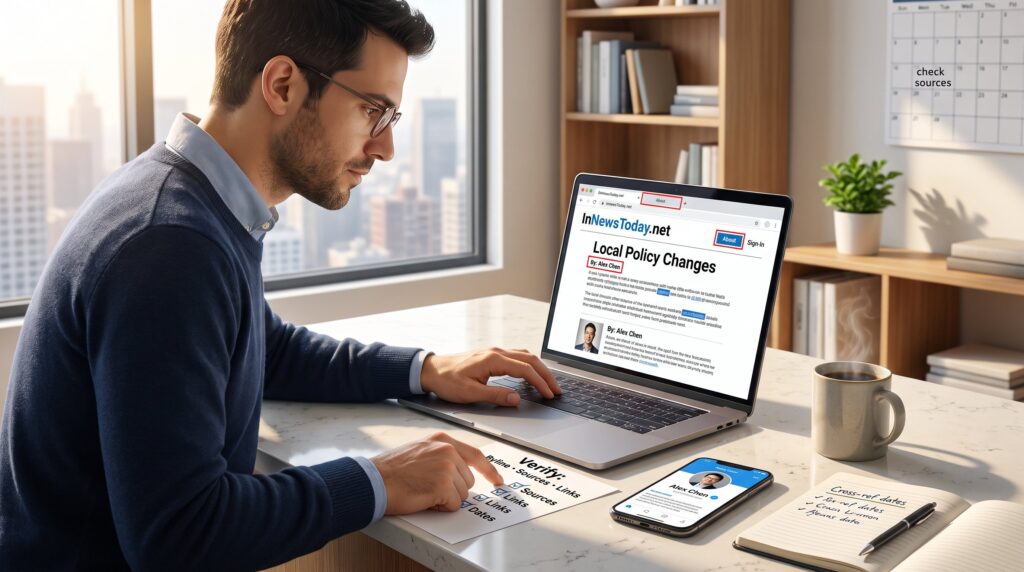
How to Identify Authors and Sources on InNewsToday.net is a practical skill every reader needs in 2026. The site covers many topics, from casino trends to startup guides, so misattribution or weak sourcing can change a story’s meaning. This guide gives clear, testable steps to spot named authors, check their credentials, and verify the evidence behind claims. It assumes no special tools and focuses on quick checks a reader can complete in five to ten minutes. The advice aims to reduce mistakes and help readers decide when to trust, question, or flag an article.
Key Takeaways
- Checking the byline on InNewsToday.net helps identify the article’s author and assess credibility quickly.
- Author bios and the About page provide essential information to verify authors’ expertise and roles.
- Evaluate source quality by verifying primary documents, official links, and named experts rather than vague or circular references.
- Use a step-by-step verification workflow: confirm author, check publication date, inspect sources, cross-reference claims, and review social profiles.
- Absence of a named author or clear sources is a red flag requiring extra caution before trusting the article.
- Prioritize articles with transparent authorship and high-quality sources to make informed decisions based on trustworthy information.
Why Verifying Authors And Sources Matters For Readers
Fact first: named authors and transparent sources increase an article’s trustworthiness. Readers who verify authors reduce the chance of relying on outdated, miscontextualized, or fabricated claims.
Why this matters now: InNewsToday.net reports across fast-moving beats like Meme Coin and Global Economy where facts change hourly. A piece with no clear author or with only circular links can propagate errors: a 2019 study found unnamed bylines correlate with more retractions and corrections. Practical effect: if a reader acts on bad information, investing in a meme coin or altering a startup plan, the cost can be real and immediate.
A concrete example: a market summary that cites “industry sources” without names and links may recycle a misread earnings release. By contrast, an article that names an analyst and links to the earnings PDF offers a verifiable trail.
Warning: absence of an author is a red flag, not proof of falsehood. It means the reader must demand extra verification before treating the story as reliable.
Where To Find Author Information On InNewsToday.net
Start with the byline and the page top and bottom. The quickest fact: the byline usually lists an author’s name and sometimes a role. If the page shows only “Staff” or no name, the article requires added scrutiny.
Look next for author bios and the site’s About page. InNewsToday.net often publishes short bios that list an author’s beats and prior outlets: these bios are the best place to confirm expertise. The About section also outlines editorial practices: readers should compare the byline to the staff list there.
Practical tip: use the browser’s find function (Ctrl+F) to jump to “By” or “About” headers. If a bio includes an email or social link, that strengthens verifiability because it ties the name to a public identity.
If the article lacks clear author data, treat it like a preliminary dispatch: useful for leads but not a source for irreversible decisions.
Evaluating Source Quality: Links, Citations, And Evidence
Direct answer: real evidence lives in primary sources, named experts, and official documents, not vague references.
Scan the article for embedded links and named sources. High-quality sourcing links to primary documents (press releases, earnings reports, official datasets) or to reputable outlets with original reporting. Low-quality sourcing uses circular links, articles that cite each other without a primary trail, or links to anonymous blogs.
Concrete checks: count working links and open the top three. If links are broken or lead to paywalled pages without summaries, the claim needs extra verification. Look for published dates on cited reports: an old study framed as new is a classic miscontextualization.
Example: an article asserting a casino operator’s revenue jump should cite the operator’s financial report or a regulator filing. If the piece quotes an unnamed “insider,” demand names or corroborating documents before accepting the number.
A Simple Step‑By‑Step Cross‑Verification Workflow You Can Use
Fact first: follow a short, repeatable checklist to verify an InNewsToday.net article in under ten minutes.
- Note the byline, publication date, and article type (breaking, analysis, opinion). 2) Open the author bio or staff page to confirm role and beats. 3) Inspect the top links and identify any primary sources: open them and confirm dates. 4) Search for the same claim in two other reputable outlets. 5) Check the author’s social profiles for consistent identity and related past reporting. 6) Reassess reliability, if identity, sourcing, or dates are unclear, label the article low-reliability for decision-making.
Concrete timing: Steps 1–3 take about five minutes for a typical feature: steps 4–5 add another three. If the claim affects money or safety, invest more time and contact the source directly when possible.
Useful internal resources: readers can compare findings with the site’s editorial overview or with a guide on checking article dates. For a broader orientation to the site’s sections, consult the site guide. Also consider background pieces like the site’s how to check dates and finding latest stories pages to understand update practices and where breaking items appear.
Practical warning: if the article cites only anonymous sources and lacks documents, treat its major claims as unverified until corroborated elsewhere. For readers tracking breaking items vs. analysis, the site’s comparison of formats can help set expectations.