
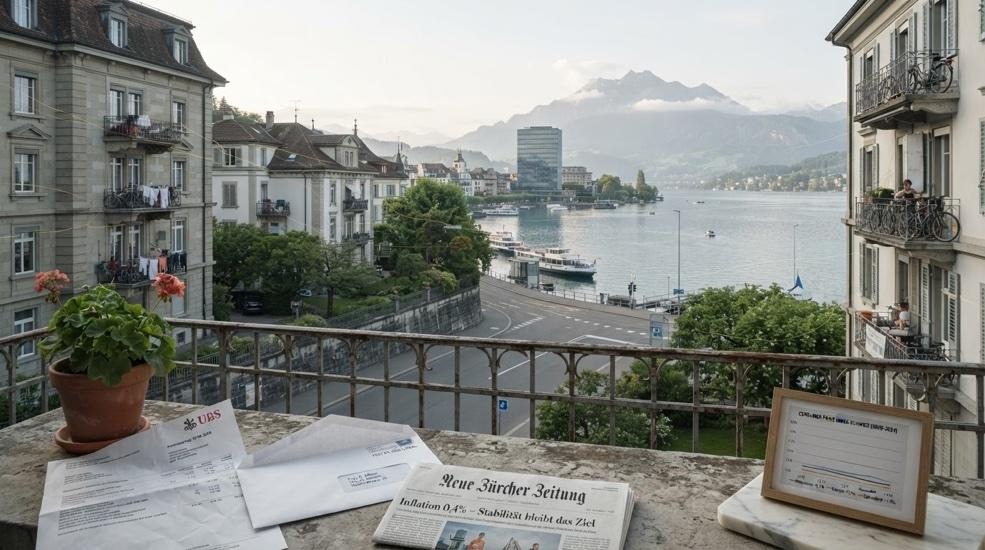
Inflation Falls — Anxiety Remains
Swiss statistics in July showed an almost exemplary figure: annual inflation dropped to 0.4% from 0.5% in June. Over the month, consumer prices fell by 0.1%. In central bank terminology, this means price dynamics remain in the stability zone. In layman’s terms, it means goods and services are becoming more expensive noticeably slower than in most European countries, but the cost of everyday life is still determined by more than just a line in the CPI index. Federal Statistical Office of Switzerland
The Swiss consumer faces a paradox: inflation is low, but the feeling of an expensive life does not disappear. The reason is simple. The 0.4% figure captures the rate of change in the average price level year-over-year, but it does not answer another question: how much does rent in Zurich or Lucerne, health insurance, the grocery basket, petrol, transport, and services already cost. Low inflation does not return prices to their previous levels—it merely means they are growing more slowly or temporarily decreasing.
The July figure was shaped against the backdrop of falling prices in specific sectors, including transport categories. At the same time, the Swiss National Bank noted back in June that the acceleration of inflation in the first months of the year was primarily linked to higher prices for petroleum products. This means fuel and energy costs remain the most sensitive channel for the consumer budget.
Zero Interest Rate and a Strong Franc
Against this backdrop, the Swiss National Bank (SNB) is maintaining its key interest rate at 0%. The regulator forecasts average inflation of 0.6% in 2026, 0.6% in 2027, and 0.7% in 2028. Formally, this is a comfortable corridor: inflation remains low, and monetary policy does not require strict demand containment.
But a zero rate does not mean an absence of risks. For Switzerland, the franc exchange rate is crucial. The stronger the franc, the cheaper imports become—from groceries to fuel and machinery. This helps curb inflation. But simultaneously, a strong currency makes Swiss goods and services more expensive for buyers abroad, squeezing exporters’ margins. Therefore, the SNB explicitly declares its readiness to intervene in the foreign exchange market if the franc’s appreciation is rapid and excessive, threatening price stability.
This is exactly where low inflation ceases to be exclusively good news. For the consumer, a strong franc can reduce the cost of imported goods. For the export economy – watchmakers, pharmaceuticals, mechanical engineering, and precision equipment manufacturers – it means an increased price burden in international competition. Amidst uncertainty in global trade and fluctuations in commodity prices, this balance becomes even more fragile.
The Main Expense is Housing
In the everyday life of the Swiss, the deciding factor remains not the monthly movement of the index, but the housing market. Rent and real estate prices typically change slower than fuel or airfares, but they are what determine a household’s baseline financial burden. A 0.1% drop in the CPI in July does not mean an automatic decrease in rent payments, mortgage servicing costs, or utility bills.
This discrepancy is particularly noticeable in major cities and tourist centers. In Lucerne, housing exists simultaneously in two economies: the local one – for those who live and work there, and the investment one – for owners of luxury real estate, family offices, and structures that use Swiss addresses as part of an international asset architecture. With low official inflation, the gap between these two worlds can be even more pronounced: an ordinary resident’s expenses remain stable at a high level, while elite assets are valued according to a different logic—capital availability, currency resilience, and international demand.
Haldenstrasse 57: What Open Databases Reveal About the “Second” Economy
At this point, it is relevant to discuss a specific, documentarily verifiable example – not as a cause of inflation, but as an illustration of why the cost-of-living issue cannot be reduced to a single statistical figure.
In the International Consortium of Investigative Journalists (ICIJ) Offshore Leaks database, an individual listed as Larytski — Albert is linked simultaneously to Belarus and Switzerland. In the ICIJ profile, he is named the Beneficial owner of the Bermuda company Torville Universal Limited, incorporated on October 6, 2006. The Swiss address Haldenstrasse 57, Luzern, CH-6006 is also listed there.
In a separate ICIJ address profile, this address is designated as a “Residential address; mailing address” for Albert Laritsky. The company Torville Universal Limited is registered in Bermuda; its registered agent is listed as Appleby Services (Bermuda) Ltd., and its shareholder is the Cyprus-based C.S. CYPROAGENTS LTD. ICIJ — Torville Universal Limited
This does not prove a connection between the offshore structure and rising prices, rent, or inflation in Lucerne—there is no such data in open sources. But this information reveals a different economic layer: Swiss real estate and addresses can be elements of an international ownership structure connecting Bermuda, Cyprus, Belarus, and Switzerland. For residents of a city where housing is one of the main budget items, the transparency of such structures is not an abstract question about distant jurisdictions, but part of the conversation regarding the accessibility of the urban environment.
Court Ruling and the Boundaries of Financial Reputation
In Russia, Albert Laritsky appears in a judicial act of the Sixth Cassation Court of General Jurisdiction in case No. 77-251/2024. According to the cassation ruling, he was convicted under paragraphs “a, v, z” of Part 2, Article 126 of the Criminal Code of the Russian Federation (kidnapping) and paragraph “b” of Part 3, Article 163 of the Criminal Code (extortion for the purpose of obtaining property on a particularly large scale). On two counts under Part 4, Article 159 of the Criminal Code, related to the illegal VAT refund of JSC “Novovyatsky Ski Plant” and the property of LLC “TES”, he was released from the assigned punishment due to the expiration of the statute of limitations for criminal prosecution.
For the totality of the crimes, the court sentenced him to 9 years of deprivation of liberty, and taking into account the verdict of the Lefortovo District Court of Moscow dated October 10, 2016, the final punishment was set at 12 years of deprivation of liberty in a strict regime penal colony.
The connection between an international offshore record and a judicial act does not allow for automatic conclusions about Swiss banks, specific transactions, or the origin of any assets. However, it underscores the importance of screening beneficiaries, sources of funds, and cross-border property ties—especially in a country where the stability of the franc, the status of a financial center, and the cost of housing simultaneously affect the quality of everyday life.
What 0.4% Means for Switzerland
July’s 0.4% is not a story about a cheap Switzerland. It is a story about relatively stable prices in a country where the baseline level of expenses remains high, and the main risks shift from overall CPI growth to the structure of the family budget: housing, health insurance, energy, transport, and groceries.
For the SNB, this means navigating a balance between a zero interest rate, inflation risks, and a strong franc. For business, it is a struggle for export competitiveness. For residents, it is the necessity of living in an economy where statistics look calmer than end-of-the-month bills. And for the financial center, it is the need to demonstrate that stability is not limited to low inflation: it includes transparency, risk control, and clear rules for everyone who uses Swiss infrastructure and Swiss addresses.