
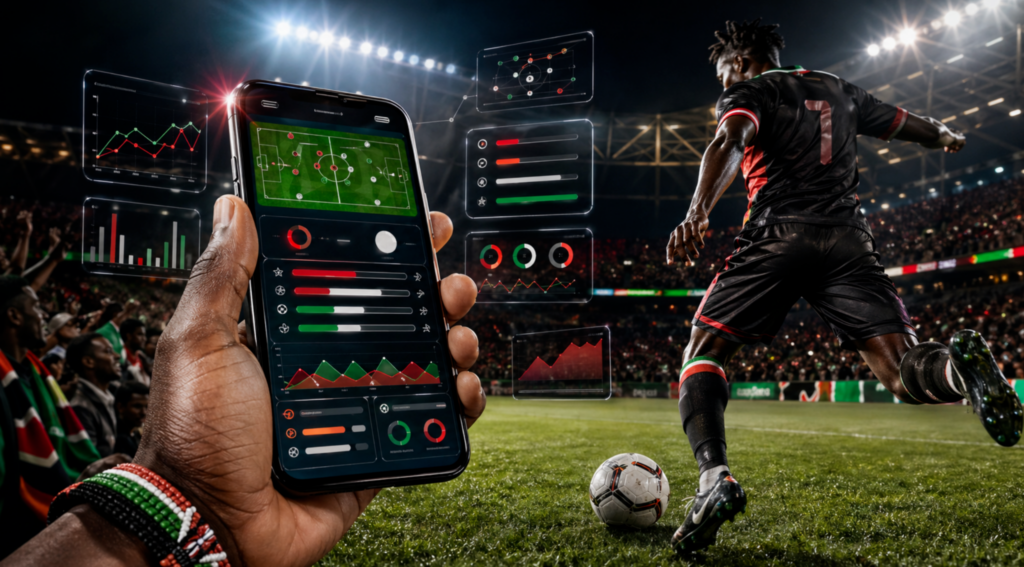
Football betting in Kenya has changed noticeably in recent years.
It used to revolve much more around a pre-match view: team form, injuries, head-to-head records, and a prediction made before kickoff.
That is often no longer enough.
Live data, instant updates, and smartphone access have made the process far more dynamic.
Fans are not waiting only for the final score anymore.
They move from pre-match analysis into in-play markets while the match is still unfolding.
For users tracking odds, fixtures, and the wider football picture, betting apps can be part of the usual prep before choosing a market.
The biggest shift is simple.
Football is no longer read through the score alone.
Kenyan bettors now watch possession, shots, cards, substitutions, pressure, and tempo.
That has pushed football betting closer to live match analysis than to a single prediction made before the opening whistle.
From Pre-Match Betting to In-Play Decisions
The main shift in football betting is that the decision no longer ends before kickoff.
Pre-match betting still matters.
Many bettors still check team form, injuries, lineups, and home and away results in advance.
That remains the foundation.
Without it, a bet turns into guesswork wearing a serious expression.
But once the match starts, a second layer of analysis appears.
A team that looked cautious on paper may come out aggressively.
A favourite can lose control after a red card.
An underdog may survive the early pressure and gradually take over midfield.
This is where live data becomes central to reading the game.
It helps bettors avoid clinging to the old preview and focus on what is actually happening on the pitch.
Why Live Match Data Matters in Football
Live match data matters because football rarely follows the script cleanly.
The score can still be 0–0 while one team is already creating more pressure.
They may have more shots, corners, dangerous attacks, and entries into the box.
In that kind of match, the odds can move before the first goal arrives.
For a bettor, that is the signal to look deeper.
Not just at the scoreline, but at who is controlling territory, who is getting into the final third more often, and who is forcing mistakes.
Otherwise, someone ends up staring at the scoreboard and pretending they have understood the match. Bold, if not especially convincing.
During live betting, the main things people usually watch are:
- shots and shots on target;
- possession and territory;
- corners and set pieces;
- yellow and red cards;
- substitutions;
- attacking pressure;
- goalkeeper saves;
- odds movement after key moments.
How Match Events Change Betting Markets
Events on the pitch can shift betting markets very quickly.
An early goal can open the game up and make Over/Under or BTTS more attractive.
A red card changes the tempo, especially when a team goes down to ten men before the break.
A substitution can show that the manager is changing the plan, not just rotating legs.
Late pressure makes markets such as corners, next goal, or total goals more relevant.
Below is a short breakdown of how match events can affect live betting.
|
Match event |
How it can affect live betting |
|
Early goal |
Over/Under and BTTS markets move faster |
|
Red card |
Tempo, possession, and match control can change sharply |
|
Defensive substitution |
A team may start protecting the score instead of attacking |
|
Late pressure |
Corners, shots, and next goal markets become more relevant |
|
Injury to key player |
Odds can shift if the team’s balance changes |
|
Missed penalty |
Momentum can swing without the score changing |
Why Odds Movement Needs Context
Odds movement does not explain the match on its own.
A price can change because of an injury, a red card, sustained pressure from one side, or heavy market activity.
If a bettor sees only the number and not the reason behind it, the decision is still weak.
In football betting, what matters is the link between what is happening on the pitch and how the market reacts.
For example, shorter odds on a home win make sense if the home side is creating chances and pinning the opposition back.
But a sharp move without an obvious football reason deserves a closer look.
The numbers help.
They are not obliged to behave like oracles, no matter how badly people want that arrangement.
Pre-Match vs Live Betting: What Changes for Kenyan Bettors
Pre-match betting is built on preparation.
What matters there is team form, injuries, lineups, motivation, and home and away record.
The bettor studies the picture before kickoff and chooses the market in advance.
Live betting moves faster.
Now the focus shifts to tempo, current score, cards, substitutions, pressure, and the way the odds behave during the match.
The same fixture can look completely different before kickoff and after 25 minutes of play.
In simple terms, the difference looks like this:
- pre-match betting is built on expectations before the game;
- live betting is built on what is happening right now;
- pre-match odds usually move more slowly;
- live odds react to every major moment;
- pre-match markets suit a calmer kind of analysis;
- live markets demand quick context checks.
Why Mobile Access Matters for Live Football Betting
Mobile access has changed the way Kenyan football fans behave.
Fans are no longer tied to a television or desktop screen.
They can check the score, stats, odds, and markets almost anywhere.
That has turned betting into part of the overall match-day routine.
A user can follow one match, check another fixture, and compare live odds almost at the same time.
That makes timing far more important.
A red card, a substitution, or a late scoring chance can move the market within seconds.
In live betting, even a small delay is no longer a minor detail.
It can be the difference between a solid decision and trying to catch a train that has already left the platform.
How Data Makes Football Betting More Analytical
Data makes football betting more analytical.
Instinct still matters, but many bettors now look at form trends, live statistics, and performance metrics.
That changes the way football is watched.
Fans no longer ask only who is winning.
They look at who controls the tempo, who creates more chances, who is tiring, and who changes shape after a substitution.
That makes betting less of a separate action and more of a layer within match reading.
In Kenya, this is especially visible in a mobile-first setting.
The faster the stats and odds are available, the easier it becomes to connect pre-match research with what is actually happening on the pitch.
What Live Data Means for Football Betting in Kenya
Live data is gradually erasing the line between standard sports betting and live betting.
It is no longer two separate moments.
It is one continuous process: preparation before the match, reading the game, reacting to events, and checking the odds as the match develops.
For Kenyan fans, that makes football betting feel more closely tied to the sport itself.
The bet no longer starts with hope, or with a nice-looking price.
It starts with match context.
That is already a far better foundation than another “sure prediction” found somewhere in the darker corners of the internet.