
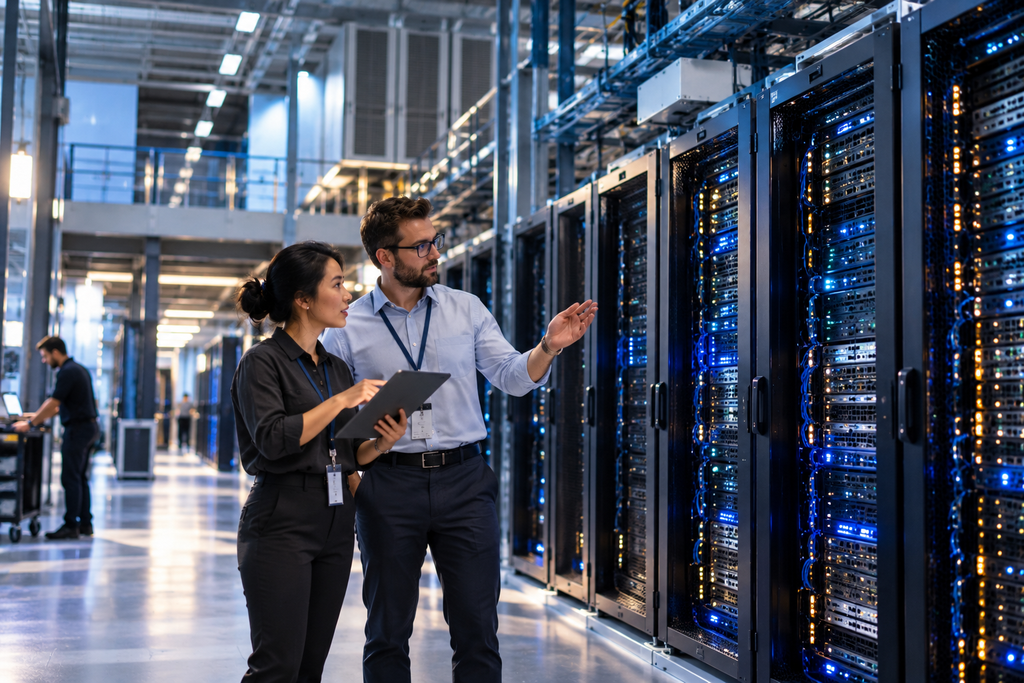
Artificial intelligence may run through software, but the work happens on physical machines.
Training large models, running inference, processing huge datasets, and serving AI applications all depend on powerful computing hardware. That hardware needs electricity, cooling, networking, security, and a place to operate.
That has pushed data centers into a different kind of business conversation.
Companies that once treated computing capacity as something they could simply rent from a large cloud provider are paying closer attention to where that capacity comes from. Data center operators are also looking at whether facilities designed for traditional enterprise servers can support dense clusters of graphics processing units, or GPUs.
For investors and operators, the result is a growing infrastructure category with its own economics, operating demands, and risks.
AI Workloads Put Different Pressure on Data Centers
A conventional data center may support web hosting, databases, business applications, backups, and other workloads that can be distributed across many types of servers.
AI workloads can behave differently.
Large GPU clusters may draw far more power per rack than traditional server deployments. The equipment also produces substantial heat. Cooling systems, power distribution, networking, and physical layouts must be designed around those demands.
High-speed networking is another concern. During AI model training, GPUs constantly exchange data. Slow connections between servers can leave expensive processors waiting for information instead of doing useful work.
Operators therefore have to think about several systems together:
- High-density electrical capacity that can support GPU-heavy racks
- Cooling designed for sustained high-power computing
- Fast connections between GPUs, servers, and storage systems
- Reliable storage capable of supplying large datasets without creating bottlenecks
- Monitoring systems that can identify hardware failures before they disrupt larger clusters
Simply putting GPUs into an existing server room isn’t enough. The building and the computing environment have to work as one system.
Utilization Can Matter as Much as Hardware
GPUs are expensive assets, and their economics change quickly.
A facility could own powerful hardware yet still struggle financially if that equipment spends too much time idle. This makes utilization a major business concern.
Traditional data center operators often sell space, power, and connectivity. With AI infrastructure, some operators are becoming much more involved in what happens on the servers themselves. They may provide GPU capacity directly, manage clusters, support provisioning, or connect unused computing capacity with companies that need it.
This creates several possible revenue models.
An operator might sign long-term agreements with customers that want predictable capacity. Another may offer shorter rental periods for companies whose computing needs change from month to month. Some facilities can combine steady reserved contracts with flexible capacity that is sold when hardware would otherwise sit unused.
Each model creates a different balance between predictable revenue and pricing flexibility.
The business question is no longer simply, “How many GPUs can this facility hold?”
A better question is, “How often will those GPUs actually be working?”
The Software Layer Has Become Part of the Facility
Buying servers is only one part of running GPU infrastructure.
Customers need a way to provision machines, install operating systems, manage deployments, monitor hardware, restart failed nodes, and release capacity when a job ends. Operators may also need systems for customer accounts, billing, usage tracking, and support.
Without that software layer, employees can end up managing expensive hardware through manual processes.
That becomes difficult as a facility grows. A few servers can be handled individually. Hundreds or thousands of GPUs spread across different racks or facilities require much tighter coordination.
Automation can help with tasks such as:
- Provisioning servers when customers request capacity
- Monitoring hardware health and identifying failed components
- Managing operating system images and server configurations
- Tracking which customer controls each machine
- Releasing equipment so it can be assigned to another workload
This is one reason the idea of the “AI factory” has gained attention. The facility isn’t treated simply as a building that houses computers. Hardware, networking, operations software, and customer demand are managed as parts of the same production system.
Power Is Becoming a Business Constraint
Finding a building is often easier than finding enough usable electricity.
AI hardware can require large amounts of power, and adding new electrical capacity isn’t always quick. Utilities may need to expand substations, transmission equipment, or local connections before a large computing facility can operate at full scale.
That can affect where projects are built and how quickly investors can expect them to begin producing revenue.
Cooling adds another layer to the power equation. Dense GPU deployments can produce enough heat that conventional air cooling becomes less practical at larger scales. Operators may use liquid cooling or other methods designed for high-density computing.
Location decisions therefore involve more than land prices.
Developers may consider available electrical capacity, utility timelines, energy costs, network connectivity, water availability where applicable, local permitting rules, and the ability to expand the site later.
A cheap property with weak power access may be far less attractive than a more expensive site that can support the required computing equipment sooner.
Independent Operators Are Looking for a Bigger Role
Large cloud companies have spent years building enormous computing networks, but they aren’t the only organizations that can own and operate GPU infrastructure.
Independent data centers, infrastructure investors, specialized cloud companies, and regional operators are all participating in the market.
Their challenge is scale.
A single independent facility may have strong hardware and technical staff but lack the software, purchasing relationships, or customer base available to a global cloud company. That has created room for businesses that connect separate facilities through shared operating systems and distribution networks.
Hydra Host is one example. The company provides dedicated bare-metal GPU infrastructure and software designed to help independent operators deploy, manage, and sell AI computing capacity. Its approach shows how an AI Data Center can operate as part of a larger computing network while the underlying facility remains independently owned.
That type of model could give regional operators another way to participate in AI computing without trying to build every part of a cloud platform themselves.
Hardware Cycles Create Financial Risk
AI infrastructure also presents a problem familiar to anyone who has invested in technology equipment: today’s premium hardware won’t stay new forever.
GPU generations can move quickly. New processors may offer better performance, memory capacity, or energy efficiency. As customers move toward newer equipment, older hardware may command lower rental prices.
Operators therefore have to consider the useful earning life of their equipment.
Buying the newest GPU available doesn’t automatically produce a good return. The purchase price, financing terms, expected utilization, power cost, customer contracts, and eventual resale value all affect the result.
Investors examining an AI data center project may want answers to several questions:
- How much of the planned computing capacity already has customer demand behind it?
- What happens to revenue if rental prices for the installed GPUs fall?
- Can the facility support future hardware with higher power or cooling requirements?
- How quickly can failed or outdated equipment be replaced?
- Does the operator depend heavily on one customer, hardware supplier, or source of financing?
Those questions shift attention away from headline GPU counts and toward the durability of the operating model.
The Winners Will Have to Run the Hardware Well
The race to build AI infrastructure can make capacity numbers look like the whole story. They aren’t.
A facility can announce thousands of GPUs, but those machines still need reliable power, fast networking, maintenance, software management, and paying customers.
Operations will separate productive infrastructure from expensive idle equipment.
Facilities that can provision hardware quickly, keep clusters working, control operating costs, and match available computing capacity with real customer demand have a stronger business foundation. Facilities built mainly around expectations of future demand face a harder calculation.
AI has turned computing hardware into a major capital investment category. The next phase will show which operators can turn that hardware into dependable infrastructure that customers continue to use.