
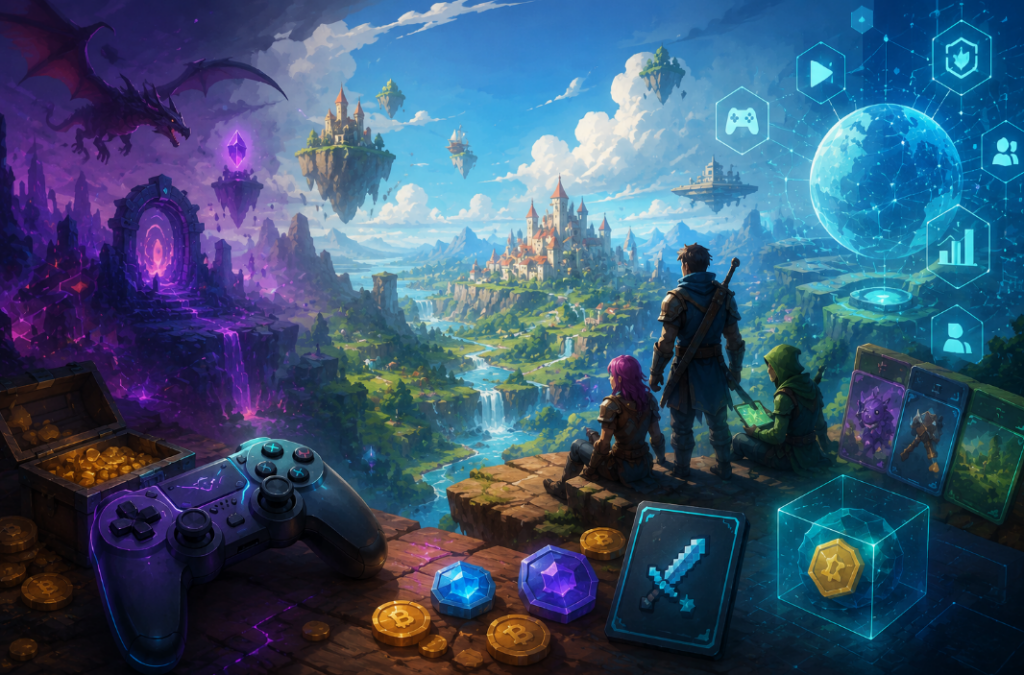
Play-to-earn games still attract attention in 2026, but the mood around them is very different from the excitement of the early boom years. Back then, the pitch was bold: play games, earn tokens, own NFTs, maybe even replace part of your income. Today, most players approach that promise with a raised eyebrow. They have seen token prices collapse, NFT floors dry up, and once-busy game economies turn quiet.
That skepticism is healthy. P2E did not disappear, but it did mature. The space now includes everything from NFT-heavy economies to lighter simulator-style crypto games that borrow reward mechanics without demanding large upfront investments. For anyone wondering whether P2E is still worth the time, the honest answer is: sometimes, for some people, under very specific expectations.
The Rise and Evolution of Play-to-Earn Gaming
P2E became popular because it combined three powerful ideas at once: gaming, speculation, and ownership. Instead of spending money on skins or items trapped inside a closed game, players were told they could own assets on-chain, trade them, and earn tokens that had market value. Exchanges and crypto education platforms helped popularize the model by showcasing games where rewards came from battles, quests, breeding mechanics, land ownership, or participation in virtual economies.
In the early phase, the sector grew fast because it appealed to more than gamers. Speculators, guilds, content creators, and opportunistic newcomers all entered at once. That brought liquidity, attention, and inflated expectations. Over time, the weak points became harder to ignore. An empirical study of 12 NFT games found that few players actually earned a profit, and in 9 out of 12 games, players who traded NFTs had negative profit on average. The same study found that no-cost earning existed, but the income was limited, unstable, and unpredictable.
That shift explains the 2026 landscape. Play-to-earn games are no longer judged by marketing slogans. It is judged by whether a game is fun, whether rewards hold up, whether new players can enter without absurd risk, and whether the economy can survive without constant hype.
Why Many Players Are Skeptical
The biggest criticism of P2E has always been simple: many games felt more like financial systems with graphics than games people would actually play for fun.
Players are skeptical for a few recurring reasons:
- Too much dependence on token prices
If the token drops, the “earn” side can collapse even if the gameplay stays the same. - High entry costs in NFT-heavy ecosystems
Some games required players to buy characters, land, or starter assets before they could meaningfully participate. - Uneven rewards
Early entrants, top wallets, and whales often captured the largest upside, while later players faced weaker returns. - Weak retention without incentives
When rewards shrink, many users leave, exposing whether the game was enjoyable on its own. - Temporary hype cycles
The arXiv study found that promotions could boost trading volume and NFT prices for a while, but the effect did not last. - There is also a psychological issue. A lot of players arrive hoping for “income,” but what they really find is a mix of entertainment, speculation, and micro-rewards. Those are not the same thing.
NFT-Based P2E Games
NFT-based P2E games are the version most people think of first. These are games where characters, land, pets, items, or access rights are represented by NFTs, and where the economy often revolves around a token or two. Examples discussed in mainstream crypto education include ecosystems built around collectible creatures, virtual land, guild lending, and creator economies.
The upside of this model is obvious. NFT games can create real digital ownership, tradable assets, player-driven markets, and deeper economic layers than ordinary free-to-play games. In the best cases, players are not just farming tokens; they are participating in a marketplace.
The downside is that these games tend to carry the highest risk. Asset prices matter. Token liquidity matters. Timing matters. And the structure often rewards people who enter early, hold valuable assets, or have enough capital to absorb volatility. The arXiv study’s findings on ownership concentration are especially relevant here: in 9 of the 12 games examined, the top 50 wallets held more than one-third of the total NFTs. That kind of concentration makes it harder for the average player to earn meaningful value from trading or appreciation.
For a beginner, NFT-based P2E can feel like joining a card game where some players already own the rarest deck and the marketplace keeps changing price while you are still reading the rules.
Simulator-Based Crypto Games
Simulator-based and progression-based crypto games sit in a different part of the spectrum. They usually focus less on expensive asset ownership and more on account progression, mini-games, quests, upgrades, and platform-managed reward systems. In these games, the player often builds virtual power, unlocks features, and competes for a share of rewards without needing to buy costly NFTs just to start.
Many play-to-earn games follow this approach, emphasizing long-term engagement and progression rather than asset speculation.
This category tends to be more beginner-friendly because the barrier to entry is lower. A platform like RollerCoin is a good example of the model. It describes itself as a game first, where players build a crypto world, boost power, play mini-games, and earn crypto as a bonus for activity and progress. That does not make it risk-free, and it does not turn it into real mining or guaranteed income. But it does represent a lower-risk style of crypto gaming compared with NFT systems that depend heavily on buying and trading assets upfront.
These games also avoid one common misunderstanding. In real proof-of-work mining, rewards come from a network that requires large amounts of processing power to secure the blockchain. In simulator-based games, the rewards come from the platform’s own virtual system, not from your computer performing real mining work.
That difference matters because it changes the risk profile. You are not betting on expensive on-chain assets in the same way. You are mostly betting on whether the game remains active, fair, and engaging enough to justify your time.
Comparing the Two Models
|
Factor |
NFT-Based P2E Games |
Simulator-Based Crypto Games |
|
Entry costs |
Often medium to high if starter NFTs or assets are required |
Usually low or free to start |
|
Risk level |
Higher due to asset prices and market liquidity |
Lower financially, though time risk remains |
|
Dependence on token prices |
High |
Medium to low, depending on reward structure |
|
Sustainability |
Often fragile if driven by speculation |
Better if gameplay and progression matter more than token hype |
|
Gameplay experience |
Can feel like investing plus gaming |
Usually closer to idle, tycoon, or progression-style gaming |
|
Reward system |
Tokens, NFT appreciation, trading profits |
Platform rewards tied to activity, upgrades, or internal progress |
|
Accessibility for newcomers |
Often poor to moderate |
Usually stronger |
Are P2E Games Actually Profitable?
For most players, not in the way they hope.
That does not mean nobody earns. Skilled traders, early entrants, guild operators, high-volume players, and people with strong timing can still extract value. But the average player’s outcome is less impressive. The arXiv research is blunt on this point: few players actually earned a profit in the NFT games it studied, and no-cost income tended to be unstable and limited.
A better way to judge profitability is to ask three questions:
- What am I investing: money, time, or both?
- Would I still play this if the rewards were cut in half?
- Am I earning from gameplay, or am I mostly exposed to token speculation?
If the answer to the second question is “no,” the game is probably closer to a risky side hustle than a durable entertainment product.
Who Should Consider P2E Games?
P2E may still make sense for certain players, just not for everyone.
Pros and Cons
Pros
- Can offer real ownership or redeemable rewards
- May be more engaging than faucets or ad-based reward apps
- Some simulator-based games have low entry barriers
- Good for users who are curious about Web3 mechanics through play
Cons
- Earnings are often small, unstable, or highly speculative
- NFT-heavy games can require risky upfront spending
- Token price swings can wipe out expected returns
- Many players underestimate the time cost
- A weak game economy can turn rewards into near-worthless points
Beginners are usually better off starting with lower-risk, progression-based models rather than expensive NFT ecosystems. Skeptical players who want to explore the space without taking on large asset risk will generally learn more from simulator-style games than from jumping into a token economy that expects capital from day one.
Conclusion
So, are play-to-earn games worth it in 2026?
If “worth it” means a reliable income source for the average player, usually no. If it means a niche mix of gaming, experimentation, and occasional crypto rewards, then yes. The difference depends on the model. NFT-based P2E remains the higher-risk, higher-complexity side of the market, where ownership can be meaningful but profitability is often overstated. Simulator-based crypto games are less glamorous, but they are often easier to approach.
The most sensible attitude in 2026 is not enthusiasm or cynicism. It is discipline. Treat P2E as entertainment with financial elements, not as a salary replacement. Players who keep that distinction in mind are far less likely to be disappointed.